ISP Email Shutdowns in 2026: Which Email Domains Are Closing, and What It Means for Your List
Internet providers are closing the email addresses that came with home broadband. Here's which ones closed or are closing, why a working address can turn into a hard bounce overnight, and what to do with those subscribers before your next send.
 Written byBounceLayer Team
Quick answer
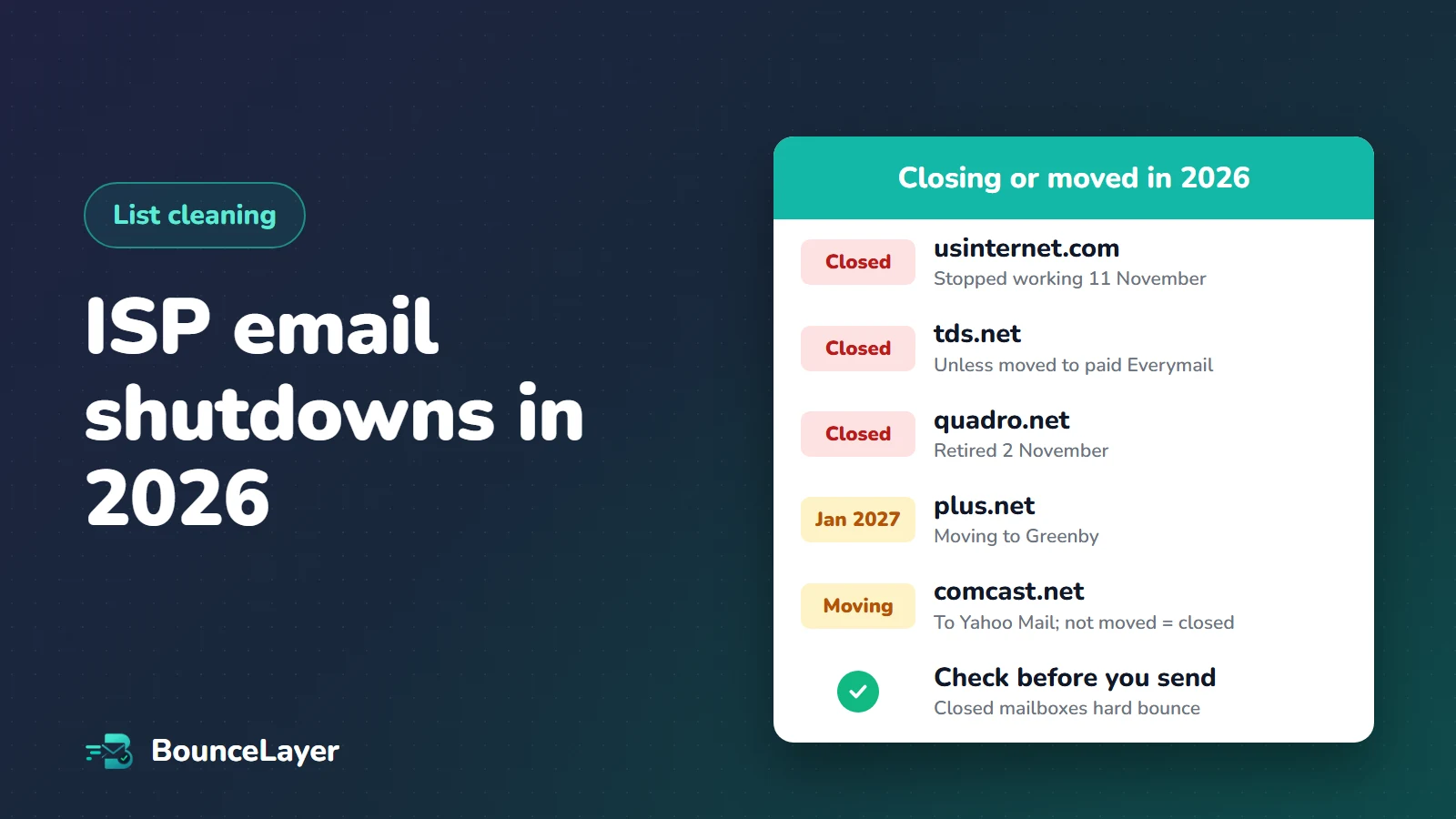
In 2026 many internet providers stopped running email for their customers. US Internet's addresses (such as @usinternet.com) stopped working on 11 November 2026, TDS Telecom closed tds.net mailboxes that weren't moved to the paid Everymail service, Quadro (@quadro.net) closed on 2 November, Plusnet's own email closes in January 2027, and Comcast.net accounts are moving to Yahoo Mail. When a mailbox is closed, email sent to it hard bounces. If your list has subscribers on these domains, check those addresses before your next send, ask the people behind them for a new address, and suppress any that bounce.
What is happening to ISP email addresses
For decades, signing up for home broadband came with a free email address: @tds.net, @comcast.net, @plus.net and hundreds more. Many people still use these as their main address, often for 20 years or more, and often on the sign-up forms of the businesses that email them.
Running email costs internet providers money and earns them nothing, so one after another they are closing it. In May 2026 the industry site Emailexpert described the trend as "The 2026 Great ISP Email Retreat" and warned: "Hard bounces will rise on legacy regional ISP domains through 2026 and into 2027." Wikipedia's list of telco consumer email services tracked 68 entries as of October 2026.
Providers take one of two routes. Some close email completely, delete the mailboxes and recommend a free service such as Gmail or Outlook. Others hand the addresses to another company, sometimes as a paid service, so customers who sign up keep their address and those who don't lose it.
Which ISP email domains are closing: the 2026 list
These are the main shutdowns and handovers reported this year. Dates come from each provider's own notice where we could find it, otherwise from the reporting named below. Where sources disagree, we say so.
US Internet's migration FAQ; TDS Telecom as reported by SpamResource (24 September 2026) and New Glarus 360 (18 November 2026); Quadro's own notice (22 April 2026); Plusnet as reported by ISPreview (November 2026); Xfinity's Yahoo migration overview; Emailexpert's review (13 May 2026); and SMTPedia's list of old email domains (November 2026). The list isn't complete: smaller regional providers close email all the time.
| Provider | Domains (main ones) | What happens | Date |
|---|---|---|---|
| US Internet (US) | usinternet.com, usiwireless.com, pixi.net, pixi.com, hula.net, alohausi.com, usihi.com, luaumail.com | Closed. Addresses stop working and forwarding ends | 11 November 2026 |
| TDS Telecom (US) | tds.net, tdsmail.com and other TDS domains | Handed to Everymail (paid). Mailboxes not moved are shut down and deleted | Sign-up deadline reported as 30 September or 31 October; local news reported the shutdown on 20 November 2026 |
| Quadro (Canada) | quadro.net | Closed. Accounts and data deleted | 2 November 2026 |
| Plusnet (UK) | plus.net | Email moved to Greenby; Plusnet's own email closes | January 2027 (no exact day published) |
| Comcast / Xfinity (US) | comcast.net | Moving to Yahoo Mail. Accounts not moved are closed and deleted | In phases through 2026 |
| Virgin Media (UK) | virginmedia.com, ntlworld.com, blueyonder.co.uk, virgin.net | Moving to Junara. Mailboxes not moved are suspended, then deleted | Rolling, with notice to each customer |
| TalkTalk (UK) | talktalk.net and others | Handed to Everymail (paid) | July 2026 |
| EONI (US) | eoni.com | Closed, with a paid extension | 1 May 2026; extension to November 2026 |
| goo mail (Japan) | goo.jp | Closed | February 2026 |
Subscribers on closed ISP domains bounce without warning. Find the dead addresses on your list before your next campaign.
Check your list freeWhy this matters to anyone who sends email
An email address isn't valid forever. The day a provider closes a mailbox, every message sent to it is rejected. That is a hard bounce, the kind mailbox providers count against your sender reputation.
The catch is that nothing on your side changes. The subscriber signed up properly, opened your emails for years and never unsubscribed. Your list looks healthy, until a campaign goes out the week after a shutdown.
- Hard bounces add up fast. Aim to keep your bounce rate under 2%; Amazon SES reviews accounts at 5%. A list with a few percent of subscribers on closed domains can push one campaign over the line.
- Long-standing subscribers are hit hardest. ISP addresses are most common among people who have had the same address for many years, often your most loyal customers.
- Some domains vanish completely. US Internet's DNS hosting ended along with its email, according to SMTPedia. When a domain has no mail server records at all, every address on it fails.
- Forwarding ends. US Internet and Comcast both stop forwarding when the old mailbox closes or moves, so "they'll still get it" is no longer true.
Handed over is not the same as safe
When a provider hands its addresses to another company, an address keeps working only if its owner actively moves. Everyone else is closed.
Comcast.net is a good example. Xfinity says customers keep their address by accepting Yahoo's terms, and that "if you do not transfer your account to Yahoo Mail, you will lose your Comcast.net email address, your email account will be closed, and email data will be deleted." TDS and TalkTalk go further: keeping the address means paying Everymail.
So a handed-over domain ends up mixed. Some addresses keep working, the rest bounce, and you can't tell which from the domain name. You have to check each address.
Removing every @comcast.net or @tds.net subscriber would throw away the people who moved and still read your email. Check addresses one by one instead, and only remove the ones that no longer exist.
What to do with subscribers on closing domains
Work through these steps before your next campaign, and repeat them as new shutdowns are announced.
Subject: "Is this still your best email address?" One or two sentences explaining that some internet providers are closing their email, and a single button to update the address. Send it only to subscribers on affected domains.
- Count them. Export your list and group subscribers by domain. Look for the domains in the table above, plus any small local internet provider domains you recognise.
- Check every address on those domains. An email verification check tells you whether the mailbox still exists before you send to it. Do it for the whole list before a big send, since not every shutdown makes the news.
- Ask for a new address while you still can. For domains that haven't closed yet, like plus.net before January 2027, send those subscribers a short message asking them to update their email, with a direct link to their preferences.
- Use other channels for valuable customers. If a paying customer's address is dead, update it through their account, a phone number or their next order rather than losing them.
- Suppress hard bounces immediately. If a campaign bounces with a "user unknown" or "domain not found" error, remove that address the same day. Don't retry it.
- Check sign-up forms. Verify addresses when people sign up, so a closed address doesn't get onto your list in the first place.
How to spot a closed domain in your bounce reports
Closed ISP mailboxes usually show up as permanent (5xx) bounces. The exact wording varies by provider, but these are the patterns to look for.
| What you see | What it usually means | What to do |
|---|---|---|
| 550 5.1.1 user unknown or mailbox not found | The mailbox was closed or never existed | Remove the address |
| Domain not found, or no MX record | The domain no longer accepts email at all | Remove every address on that domain |
| Many hard bounces from one small domain at once | The provider closed its email service | Check the rest of that domain before your next send |
| 4xx temporary errors that repeat for days | The server is being wound down or overloaded | Stop retrying after a few days and check the address |
If your own business still uses an ISP address
This isn't only a list problem. Plenty of small businesses send invoices, quotes and newsletters from an address like name@tds.net or name@plus.net. When that address closes, replies to it bounce, and any account that resets its password through it is at risk.
Move to an address on your own domain, such as you@yourbusiness.com. You keep it whichever internet provider you use, and you can set up SPF, DKIM and DMARC on it, which you can't do on an ISP's domain. Before the old address closes, update it with your bank, suppliers and every account you log in to.
Common questions
Which email providers are shutting down in 2026?
Reported shutdowns in 2026 include US Internet (usinternet.com and related domains, 11 November 2026), Quadro (quadro.net, 2 November 2026), EONI (eoni.com, May 2026) and goo mail (goo.jp, February 2026). TDS Telecom, TalkTalk, Plusnet, Virgin Media and Comcast are handing their addresses to other services, and accounts that aren't moved are closed. Plusnet's own email closes in January 2027.
Is tds.net email shutting down?
Yes. TDS Telecom handed its email to Everymail, a paid service. Customers had to sign up to keep their address (the deadline is reported as 30 September or 31 October 2026, depending on the source), and mailboxes that weren't moved are shut down and their mail deleted. Local news reported the shutdown on 20 November 2026.
Is comcast.net email going away?
Comcast.net addresses are moving to Yahoo Mail in phases through 2026. Customers who accept Yahoo's terms keep their comcast.net address. According to Xfinity, accounts that aren't moved are closed and their data deleted, and forwarding stops once an account moves.
What happens to email sent to a closed ISP address?
It is rejected and comes back as a hard bounce, usually with an error such as "550 5.1.1 user unknown" or a message that the domain can't be found. The subscriber never receives it, and the bounce counts against your sender reputation.
Should I remove all subscribers on ISP email domains?
No. On domains handed to a new provider, people who moved keep their address and still read your email. Check each address individually, remove the ones that no longer exist, and ask subscribers on domains about to close for a new address.
How do I find dead email addresses on my list?
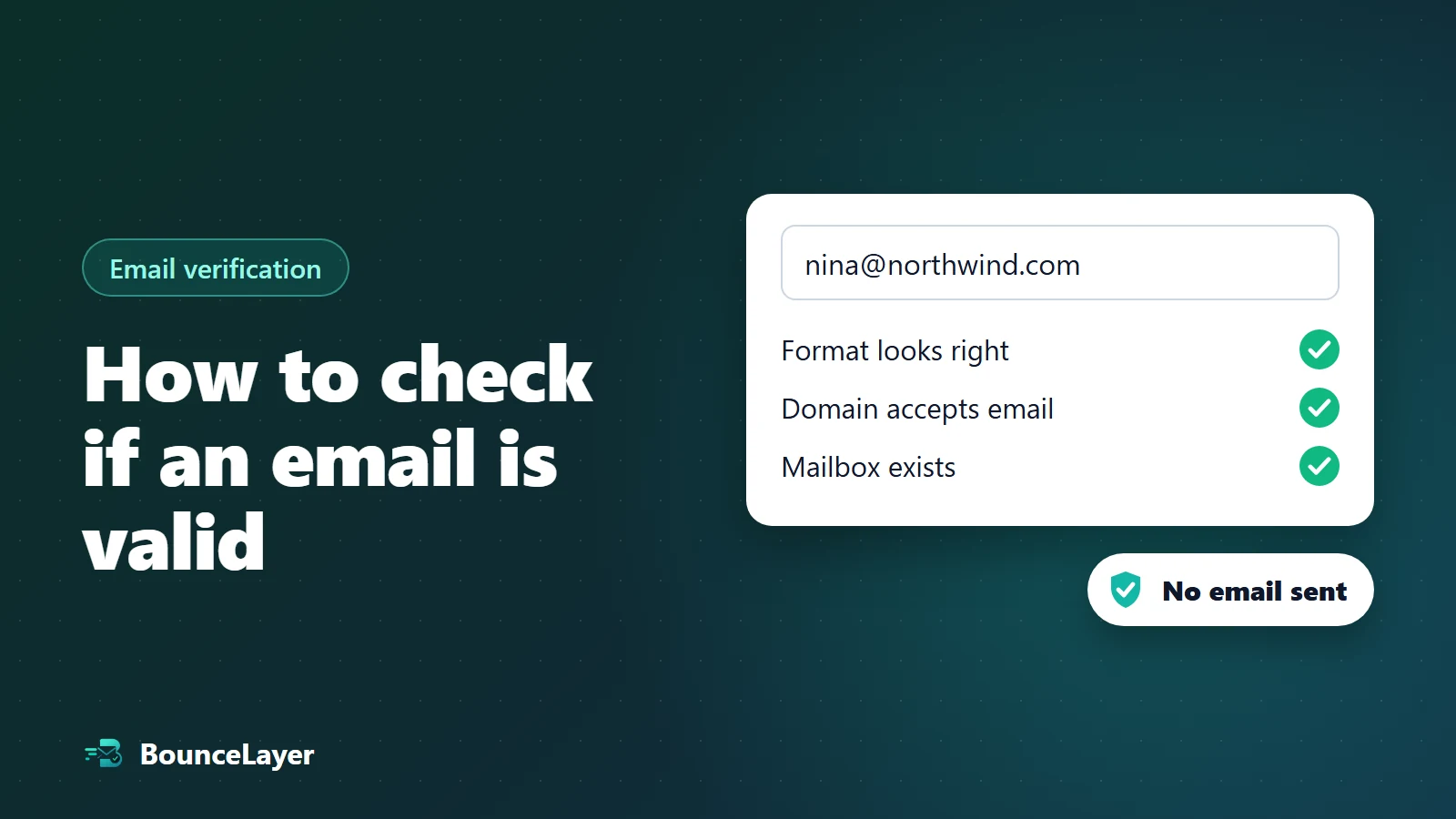
Run your list through an email verification service before you send. It checks whether each domain still accepts mail and whether each mailbox exists, without sending an email. After every campaign, also remove any address that hard bounced.
Why are internet providers closing their email services?
Running email costs money and earns providers nothing, while most people now use free services like Gmail and Outlook. Spam filtering, security and storage all add to the cost, so providers either close email or hand it to a specialist company, often as a paid service.