AI Search Is Sending Fewer Clicks: Why Your Email List Matters More in 2026
Two randomized studies now show Google's AI answers cut the clicks websites get. Here's what the research actually found, why AI recommendations are less stable than they look, and how to turn the visitors you still get into subscribers you can reach.
 Written byBounceLayer Team
Quick answer
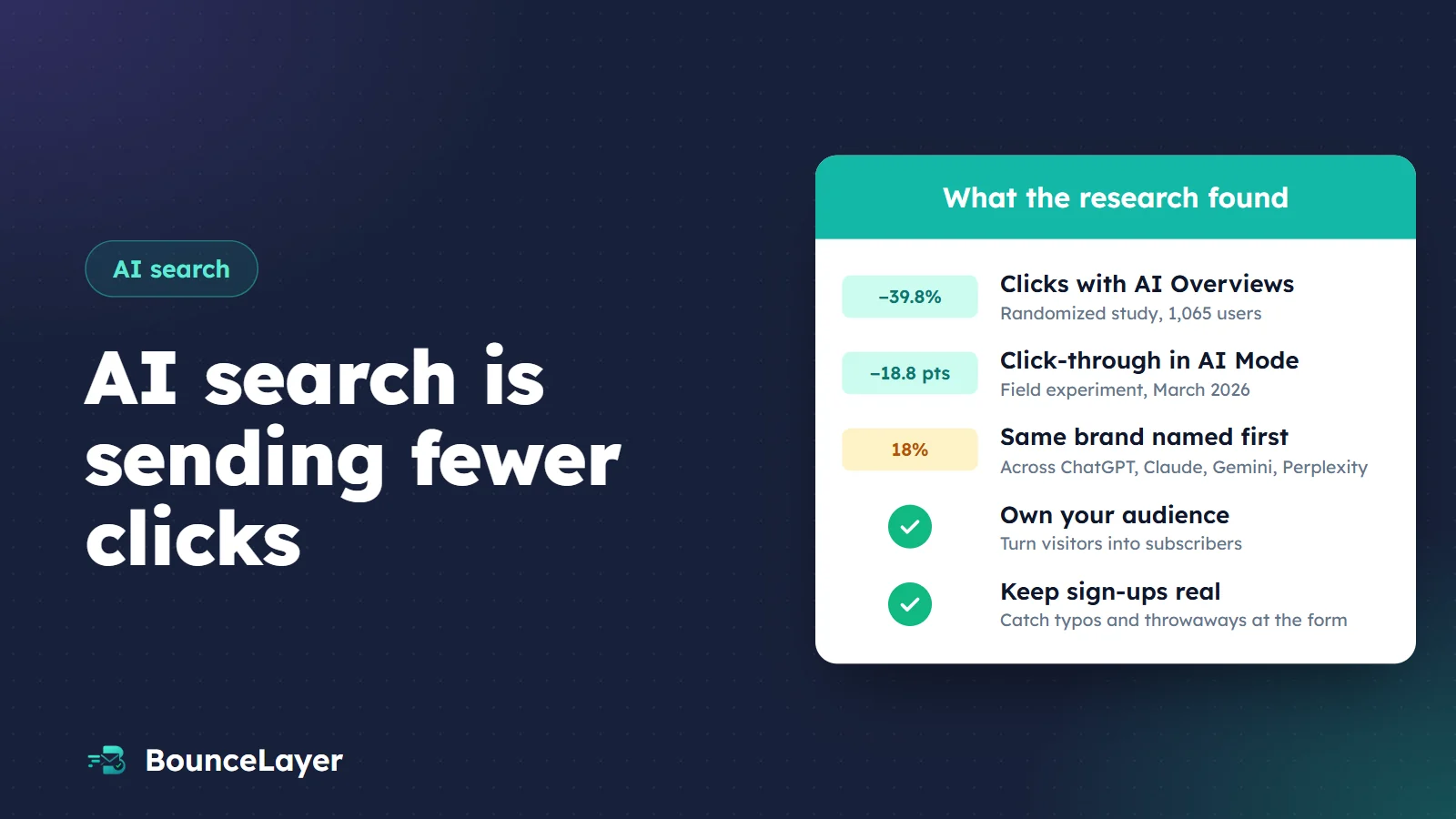
Yes, AI search sends fewer clicks. In a randomized study of 1,065 US Chrome users, Google's AI Overviews cut outbound clicks from search by 39.8%, and a second field experiment found AI Mode cut click-through to websites by 18.8 percentage points. AI assistants also change their recommendations often: in one November 2026 test, ChatGPT, Claude, Gemini and Perplexity named the same brand first only 18% of the time. Search and AI traffic you don't own can shrink overnight. An email list you own can't be taken away, so the visitors you still get are worth turning into subscribers, and the list is worth keeping clean.
What the research found
For two years, publishers said Google's AI answers were costing them visits, and Google said the clicks that remained were of higher quality. In 2026 the first randomized experiments came out. Unlike traffic charts, they compare people who saw AI answers with people who didn't, so they show cause, not just correlation.
Both studies point the same way. When people get an AI answer at the top of the page, fewer of them click through to a website.
The two randomized studies are the strongest evidence so far, but neither had been peer reviewed when this was written. The Ahrefs figure shows a link, not proof of cause. Treat the exact numbers as estimates. The direction, fewer clicks, is consistent across all three.
| Study | What was tested | Result |
|---|---|---|
| Agarwal (Indian School of Business) and Sen (Carnegie Mellon), SSRN, April 2026 | AI Overviews shown or hidden for 1,065 US desktop Chrome users, 7 January to 10 February 2026 | Outbound organic clicks down 39.8%; zero-click searches up 34.5% |
| Wang, Gleason, Wilson, Bart and Metaxa (UPenn and Northeastern), arXiv, August 2026 | Users randomly switched to AI Mode, no AI, or normal Google for a week in March 2026 (1,100 people) | AI Mode cut click-through to websites by 18.8 percentage points; people did not rate their searches as better |
| Ahrefs, February 2026 (observational) | Click-through for top-ranking pages with and without an AI Overview | About 58% lower when an AI Overview appeared |
Google's answer, and why it doesn't change the plan
In May 2026 Google announced changes meant to send more people to websites, including a "Further Exploration" section of links in AI Overviews, more link context on desktop, labels for sources you subscribe to, and more forum and first-hand perspectives. Later that month it extended Preferred Sources into AI Overviews and AI Mode.
These may help. But how many clicks reach you is still decided by someone else's design choices, and those can change in a single update. Penske Media has sued Google over AI Overviews, and European publishers have complained to the European Commission. Until that settles, plan as if search clicks will keep getting scarcer.
Every sign-up only counts if the address is real. See how to check addresses as people sign up, so typos and throwaway inboxes never reach your list.
Check sign-ups at the formAI recommendations are less stable than they look
Many businesses now try to appear in ChatGPT, Gemini, Claude and Perplexity answers. That is worth doing, but the answers move around. On 25 November 2026, Pomo, a company that sells AI visibility checks, asked the four assistants 95 buying questions in 19 categories and collected 2,660 answers.
Pomo's study covers a single morning of answers, uses its own questions and comes from a company that sells AI visibility tools. Its finding that answers vary from one ask to the next is the useful part, not any single ranking.
- All four assistants named the same brand first only 18% of the time.
- Asking the same question again kept the same first pick 70% of the time, and 29% of the brands named were new.
- Answers in India and the UK left out 43 to 44% of the brands named in the US answer.
- Software questions mostly cited the vendors' own websites (67% of citations). Product questions mostly cited publishers and review sites.
Why an email list matters more now
Search traffic and AI mentions are rented. Your list is owned. If a search update halves your visits, you can still email every subscriber the next morning, and no algorithm decides whether they hear about your launch.
That changes what a visit is worth. When fewer people arrive, the ones who do are worth more if they can become subscribers, because one sign-up can be reached again and again for free.
| Search and AI answers | Your email list | |
|---|---|---|
| Who controls reach | Google, OpenAI and others | You |
| Can change overnight | Yes, with any update | Only if you damage your sender reputation |
| Cost to reach people again | You have to win the click every time | Close to zero per send |
| Main risk | Fewer clicks | Bad addresses and spam complaints |
How to turn fewer visits into more subscribers
You don't need a pop-up on every page. Offer something worth an email address where readers are already getting value.
- Put one clear sign-up offer inside your most-read pages, next to the answer, not only in the footer.
- Offer something specific: a checklist, a template, price alerts or a short weekly summary, instead of "subscribe to our newsletter".
- Ask only for an email address. Every extra field costs sign-ups.
- Send a welcome email straight away, while the reader still remembers you.
- Use double opt-in, or at least a confirmation email, for sign-ups from public forms. It keeps fake and mistyped addresses out.
Make sure the new sign-ups are real
A growing list only helps if the addresses work. Mistyped addresses (gmial.com), throwaway inboxes and bots filling in forms all add contacts that bounce or never read. Bounces and spam complaints are what mailbox providers use to judge you, and Gmail and Yahoo hold bulk senders to a spam complaint rate under 0.3%.
Check addresses at the form, so the person can fix a typo before they leave. Then check the whole list before a big send, because addresses stop working over time as people change jobs and providers close accounts.
A sign-up form that says "Did you mean gmail.com?" saves a subscriber you would otherwise lose for good. You can't ask them later: the email never arrives.
Write pages AI answers can quote
You can't control what an AI assistant recommends, but you can make your pages easy to quote correctly. The same habits help readers who do click.
Some sites, including this one, publish an llms.txt file that summarises their pages for AI tools. It is cheap to add, but no major AI search engine has said it uses the file to rank or cite pages, so don't expect it to change results on its own.
- Answer the question in the first two or three sentences, then explain.
- Give numbers with dates and sources, so an answer can repeat them accurately.
- Use plain headings that match the questions people ask, and add a short FAQ.
- Keep facts current, and show an updated date when you change them.
- Get mentioned on the review sites and publications AI answers cite for your topic, not only on your own site.
What to measure
If AI answers cut your clicks, total visits will fall even when you are doing well. These numbers tell you more:
- Sign-ups per 1,000 visits on your main pages. This should rise as you add better offers.
- The share of new sign-ups that are real, deliverable addresses.
- Bounce rate and spam complaint rate on your sends. Keep bounces under 2%.
- Revenue or replies per email sent, which shows the list's value directly.
Common questions
Do AI Overviews reduce clicks to websites?
Yes. In a randomized study of 1,065 US desktop Chrome users from January to February 2026, Agarwal and Sen found AI Overviews cut outbound organic clicks by 39.8% and raised zero-click searches by 34.5%. Ahrefs separately found about 58% lower click-through for top-ranking pages when an AI Overview appeared, though that figure shows a link, not proof of cause.
Does Google's AI Mode send traffic to websites?
Much less than normal search. In a randomized field experiment in March 2026, researchers at UPenn and Northeastern found AI Mode cut click-through to external websites by 18.8 percentage points, and the people using it did not rate their searches as better. The study was a preprint, not yet peer reviewed, when this was written.
How do I get my business recommended by ChatGPT?
Nobody can guarantee it, and answers change from one ask to the next. What helps: pages that answer the question in the first lines, current facts with dates and sources, a clear FAQ, and mentions on the review sites and publications AI answers cite for your topic. Build your email list alongside, so your reach doesn't depend on any one engine.
Are AI assistant recommendations consistent?
Not very. In a test on 25 November 2026, ChatGPT, Claude, Gemini and Perplexity named the same brand first only 18% of the time, and re-asking the same question changed the first pick about 30% of the time. Answers also varied by country.
Why is an email list more valuable when search traffic falls?
Because you own it. Search and AI engines decide how many people reach your site, and an update can change that overnight. You can email your subscribers whenever you like, at almost no cost per send, as long as the addresses are real and your sender reputation stays healthy.
Does llms.txt help with AI search?
It may help AI tools read your site, and it is cheap to add. But no major AI search engine has said it uses llms.txt to decide what to cite or recommend, so treat it as a small extra, not a strategy.