DKIM2 Explained: What the New Email Signing Standard Means for Senders
Engineers from Yahoo, Google and Fastmail are writing a successor to DKIM. Here's what the November 2026 draft says in plain English, what it fixes, and what you should and shouldn't do about it today.
 Written byBounceLayer Team
Quick answer
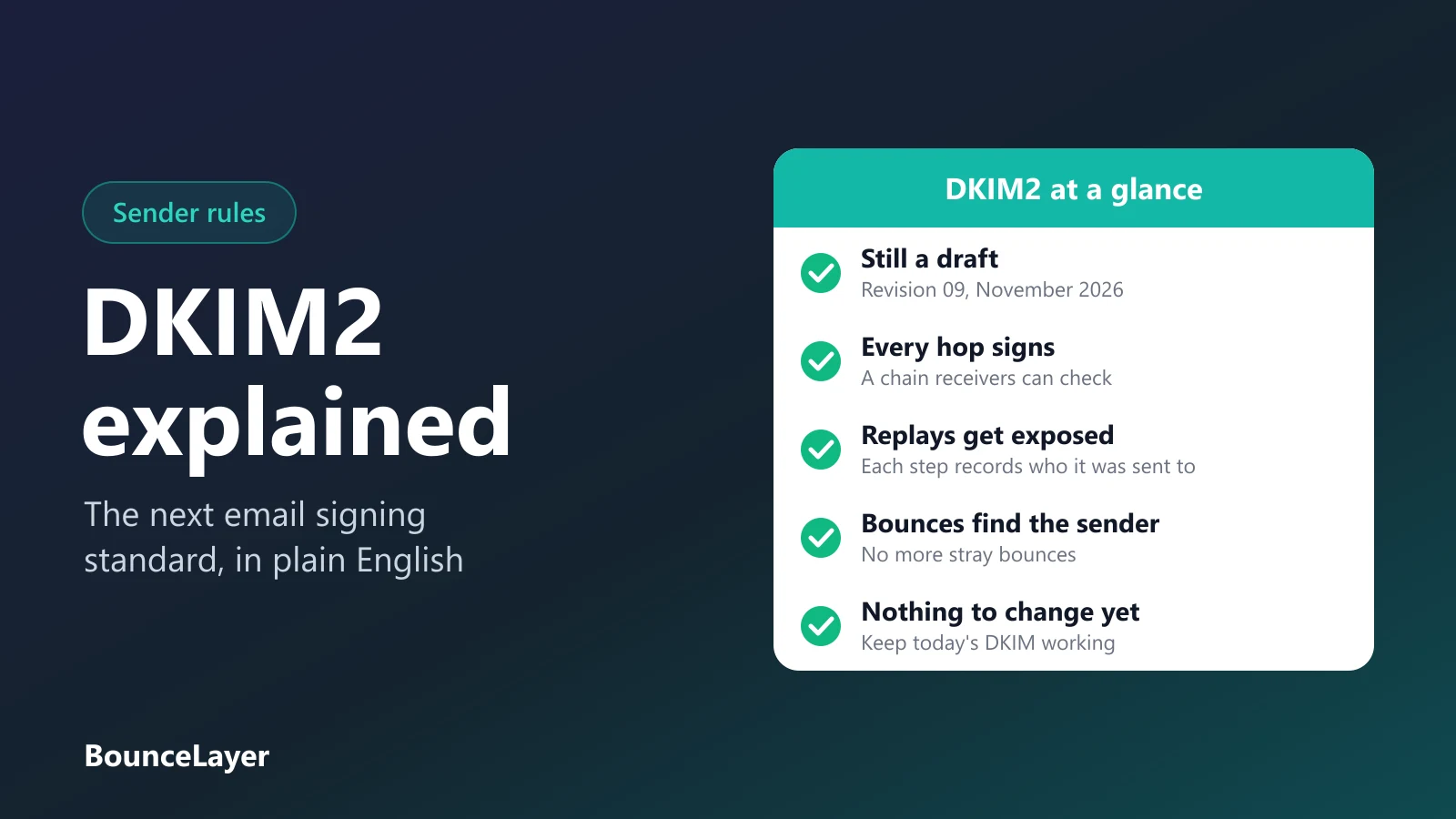
DKIM2 is a proposed replacement for DKIM, the signature that proves an email really came from your domain. It is still an IETF draft: the latest version, revision 09, is dated 1 November 2026 and is not yet a standard. The main change is that every server that handles a message adds its own signature, so receivers can see the path a message took, spot replayed copies, and send bounces only to systems that really handled it. You don't need to change anything today, and the draft's own guidance says senders should keep signing with today's DKIM during the changeover.
What is DKIM2?
DKIM is the signature your mail server adds to every email so that mail providers can check the message really came from your domain and wasn't altered on the way. It has done that job since 2011, and Gmail, Yahoo and Outlook now expect it from anyone who sends in bulk.
DKIM2 is a proposed successor. It is being written in the IETF, the body that publishes internet standards, in a document called "DomainKeys Identified Mail Signatures v2 (DKIM2)". The authors listed on the current draft work at Yahoo, Google and Fastmail. To keep the two apart, the draft calls today's DKIM "DKIM1", and so will we.
In the draft's own words, DKIM2 lets the owner of a domain "document that they have handled an email message". The difference from DKIM1 is that every system that passes the message along does this, not only the original sender.
Is DKIM2 a standard yet?
No. As of November 2026 it is an Internet-Draft, which is a working document. Revision 09 of the main specification is dated 1 November 2026. Its intended status is "Standards Track", which tells you where the authors want it to end up, not where it is now.
The IETF is clear about what a draft is. Each one carries the same notice: drafts are valid for a maximum of six months, can be "updated, replaced, or obsoleted by other documents at any time", and should be cited only as "work in progress". This revision expires on 5 May 2027 unless a newer one replaces it.
It is also still changing. Revision 09 added a new DNS record and changed how a missing signature is reported, and the companion best-practice document marks several of its own sections as open questions. Anything you read about DKIM2 today, including this guide, describes a moving target.
There are three active drafts: the main specification (draft-ietf-dkim-dkim2-spec), a document on DNS key records (draft-ietf-dkim-dkim2-dns) and a best-practice guide (draft-ietf-dkim-dkim2-bcp). All three are listed on the IETF Datatracker.
Check that DKIM is set up correctly on your domain today. It takes a few seconds and there's no sign-up.
Check your DKIM recordWhat problems is DKIM2 trying to fix?
The best-practice draft says DKIM2 is "designed to address shortcomings" in the email authentication methods that came before it, and it names SPF, DKIM, DMARC and ARC. Three problems stand out for anyone who sends email.
- Replay attacks. Someone gets one message signed by a trusted domain, then sends that exact message to huge numbers of people. The signature is still valid, so the sender's good reputation carries the spam. With DKIM1 the signer has no way to say who the message was meant for.
- Forwarding and mailing lists. When a mailing list adds a footer or changes the subject, the original DKIM1 signature breaks, and DMARC can then fail for a perfectly real message.
- Stray bounces. A bounce message goes to the return address on the email. If that address was forged, the bounce lands on someone who never sent anything. This is known as backscatter.
How DKIM2 works, in plain English
DKIM2 adds two new header fields to a message. One is called Message-Instance, and it records a fingerprint (a hash) of the message's current contents. The other is called DKIM2-Signature, and it holds the signature along with details of that step in the journey.
Each time a message is passed from one system to the next, another DKIM2-Signature is added. The draft calls the result a "Chain of Custody". Each signature records the sending address and the recipient address used for that step, plus the domain expected to sign next, so the links join up and a receiver can follow the message from the author to its own front door.
If a system changes the message, for example a mailing list adding a footer, it doesn't just break the signature. It writes down what it changed, in what the draft calls a "Recipe". A receiver can use the recipe to undo the change and check the original signature. In the draft's words, the changes "are documented so that these can be 'undone' and the original signature validated".
DKIM2 also has a rule about the From address your readers see. It must be what the draft calls "Authentic", meaning its domain matches the domain that signed the message. This builds a check that DMARC does today directly into the signature.
DKIM vs DKIM2 at a glance
Here is how the two compare, based on revision 09 of the draft.
| DKIM (today) | DKIM2 (draft) | |
|---|---|---|
| Status | Internet standard, in use everywhere | IETF draft, not yet a standard |
| Who signs | Usually just the sender | Every system that handles the message |
| Header fields | DKIM-Signature | Message-Instance and DKIM2-Signature |
| Records who it was sent to | No | Yes, the sender and recipient address for each step |
| When a forwarder edits the message | The signature breaks | The change is recorded so it can be undone and checked |
| Replayed messages | Hard to tell from real ones | The chain shows who passed the message on |
| Bounces | Sent to the return address, even a forged one | Sent only to systems that handled the message |
| Signing methods | RSA and Ed25519 | RSA, Ed25519 and ML-DSA-44, a post-quantum method |
| Where keys live | DNS, under _domainkey | The same place, in the same format |
How DKIM2 changes bounces
This is the part most relevant to list quality. Under DKIM2, when a message can't be delivered, the bounce goes to the sending address recorded in the newest signature on the message. That address must match the domain that signed it. So a bounce for a checked message can only go to a system that really took part in delivering it, and not to a stranger whose address was forged.
The draft then expects the bounce to be passed back along the path, one step at a time, "until a system is reached that is prepared to take full responsibility for the failure event". It says this gives every system on the path "the opportunity to adjust their future sending behavior".
Put simply, DKIM2 is designed so that the news of a bad address reliably gets back to whoever sent to it. That makes it harder to ignore bounces, and it makes a list full of dead addresses more visible to everyone who carries your mail.
Hard bounces already hurt your sender reputation. A standard built to route every bounce back to the responsible sender only raises the value of removing bad addresses before you send.
What should senders do now?
Nothing urgent. The draft sets no deadlines, and it is not yet a standard that a mail provider could require. When it does arrive, the change is expected to be gradual: the best-practice draft says signers should use both DKIM1 and DKIM2 until DKIM2 is everywhere, and that receivers should not treat a missing DKIM2 signature as a reason to reject mail during the changeover.
DKIM2 also stores its keys in DNS the same way DKIM1 does, so the work you put into DKIM today carries over. These are the things worth doing now, because they help under both.
- Check that DKIM is working on every stream you send, including your marketing tool, your help desk and your invoicing system. A free DKIM checker will show you the record for each selector.
- Use keys of at least 2048 bits. The DKIM2 draft keeps the same advice that has applied to DKIM since 2018.
- Sign with your own domain, not only your email provider's. DKIM2 requires the From domain to match the signing domain, and DMARC already rewards this today.
- Rotate keys by publishing a new selector instead of overwriting the old one, so mail already in transit still verifies.
- Process your bounces and remove hard bounces straight away. DKIM2 is built to get bounces back to you, so a habit of acting on them will matter more, not less.
- Ask your email provider whether DKIM2 is on its roadmap. For most senders the provider will do the signing, so this will arrive as a setting, not a project.
What we still don't know
It's worth being honest about the gaps. The draft does not say when DKIM2 will be finished, and no revision of a draft is a promise that it will be published.
The role of DMARC and SPF once DKIM2 is widely used is undecided. The best-practice draft raises both questions under headings it marks as open, and says the DMARC question "remains an area of active Working Group discussion".
The feedback feature is unfinished too. A signer can add a flag asking for feedback on how a message was handled, such as whether it was treated as spam. But the specification says it "does not describe what such feedback might be or where it might be delivered".
We'll update this guide as new revisions are published.
Common questions
What is DKIM2?
DKIM2 is a proposed successor to DKIM, the signature that proves an email came from your domain. Every system that handles a message adds its own signature, creating a chain that receivers can check. It is being developed in the IETF and is not yet a standard.
Is DKIM2 a standard yet?
No. As of November 2026 it is an IETF Internet-Draft. Revision 09 of the main specification is dated 1 November 2026 and is intended for the standards track, but drafts can change or be replaced at any time.
Do I need to set up DKIM2 now?
No. There is nothing to deploy yet and no deadline. The draft's best-practice guidance says senders should sign with both DKIM and DKIM2 during the changeover, so keep your current DKIM setup working.
Will DKIM2 replace DMARC and SPF?
That hasn't been decided. DKIM2 builds a From-domain check into the signature, which overlaps with DMARC, but the working group's own best-practice draft lists the future of DMARC and SPF as open questions.
What is a DKIM replay attack?
It's when someone takes one message that a trusted domain signed and sends that same message to huge numbers of people. The signature is still valid, so the spam borrows the signer's reputation. DKIM2 records who each message was sent to, which makes replayed copies easier to spot.
Who is writing DKIM2?
The authors listed on revision 09 of the specification work at Yahoo, Google and Fastmail. The work is done in the IETF's DKIM working group.